Wolf Oven Repair
Wolf Oven Bakes Long and Runs Cool: Reading the Drift
An oven that needs twenty extra minutes on every recipe is rarely broken — it is usually reading its own cavity wrong. How to tell sensor drift from a failed sensor, what to check before buying parts, and what Phoenix water and monsoon outages add to it.
Written by Dallas McGivern Cooking-appliance technician — griddles and charbroilers · 10 years in the trade
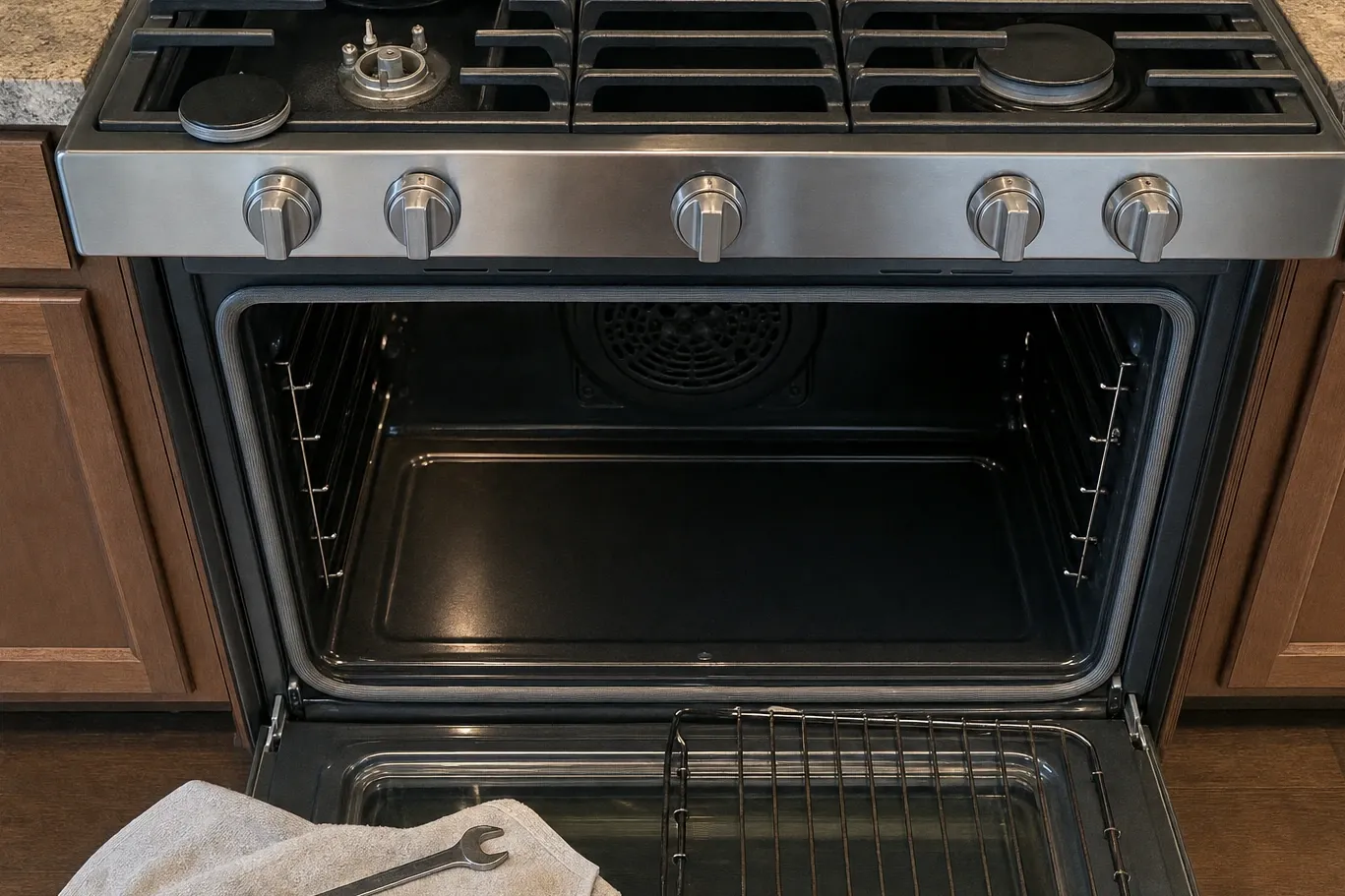
The complaint arrives the same way almost every time: everything takes longer than it used to, biscuits come out pale, and the recipe that always worked now needs another twenty minutes. Nothing has failed. No error code, no dead cavity, no smell. The oven simply is not as hot as it says it is.
That is drift, and it is the most common oven fault we get called out for in Phoenix that does not announce itself. It is also the one most likely to be met with a new control board it did not need, so it is worth understanding what is actually being measured.
What runs cool usually means
A Wolf oven does not have a thermostat in the old bimetal sense. It has a resistance temperature sensor — a small probe in the cavity whose electrical resistance changes predictably with heat — and a control that converts that resistance into a temperature and decides when to call for more.
The important consequence is this: the control is not measuring temperature. It is measuring resistance and believing it. If the sensor’s resistance curve has shifted with age, the control reads a cavity that is hotter than it really is, stops calling for heat too early, and holds the oven twenty or thirty degrees below the setting. Every part in the chain is working exactly as designed. The number they agree on is simply wrong.
That is why a genuinely cool oven so rarely throws a fault code. A code needs a value outside the plausible range — an open circuit, a short, a cavity that never warms. A sensor reading believably but incorrectly is invisible to the control’s own diagnostics and only visible to a second thermometer.
Sensor drift versus a dead sensor
These need separating before anybody spends money, and the difference is straightforward.
A dead sensor is an open or shorted circuit. The oven usually refuses to run, or runs and throws a code, or heats without ever stopping because the control believes the cavity is stone cold. It is abrupt: it worked on Tuesday and did not on Wednesday.
A drifted sensor is gradual. It bakes a little long, then longer, over months. Resistance measured cold sits above where it should be for the ambient temperature. The oven still cycles, still holds a steady temperature, and holds it steadily in the wrong place.
The distinction matters because drift has two other candidates behind it that a sensor swap will not touch:
- A door that no longer seals. Tired hinge springs let the top corner stand proud by a millimetre or two, and heat runs out over the handle rather than staying in the cavity. The control is reading correctly; the cavity genuinely cannot hold the setting. Springs and gasket go together — a new gasket against tired springs crushes flat inside a month.
- A bake element or gas burner that has lost output. Less common, but a burner starved by a partly blocked orifice or an element with a section of failed winding will heat the cavity slowly and undershoot on a long bake, while looking normal to the control.
Check these four things first
None of this needs tools you do not own.
- Put a second thermometer in the cavity. An oven thermometer on the middle rack, set to 350°F, and then leave it forty minutes — not ten. The first cycle overshoots and undershoots by design. Read it once the oven has settled and the light has cycled twice.
- Test the seal, corner by corner. Trap a sheet of paper in the shut door at the top corner and draw it out, then repeat at the bottom corner and down each side. If the top releases noticeably more easily than the bottom, the springs are the story and the sensor is innocent.
- Look at the gasket where it turns the corners. Flattened, glazed or split at a corner is a seal that lost the argument some time ago.
- Note whether it is cool everywhere or cool at the top. Uniformly cool points at reading or sealing. Cool at the top with a hot base points at airflow, which is a fan or a baffle question rather than a temperature one.
Write the numbers down. An engineer arriving to it bakes long has to start from nothing; one arriving to forty minutes to settle, twenty-eight degrees under at 350, paper slides at the top left corner can go more or less straight to it.
The Phoenix variables: outages and hard water
Two local things distort this picture and both come up regularly.
The first is the monsoon outage. A hard power cut and restart is where marginal electronics give up, and on a dual-fuel range the electric oven takes it while the gas cooktop shrugs. The classic pattern in August is a cooktop that works perfectly beside an oven that has lost its clock, its relay or its thermal fuse. That is not drift and it does not present as drift — it is abrupt, and it is a different repair.
The second is water, and it only affects convection steam ovens. Phoenix water scales a steam generator and its pump faster than the manual’s service interval assumes. The machine asks to be descaled, gets ignored for a month, and then refuses to start at all. Descaling clears the fault; if the pump has already seized under scale, it is a pump. Either way, the temperature complaint that arrived alongside it is often just the steam cycle failing rather than the cavity running cool.
When the oven is fine and the recipe is not
Worth saying plainly, because we get called out to it. An oven holding within fifteen degrees of its setting is inside the range it was built to, and no amount of work will make it tighter. If bakes have changed but the thermometer agrees with the dial, look at what else changed — a different rack position, convection left switched on or off, dark trays instead of light ones, or a cavity that simply was not preheated as long as it used to be because the kitchen is forty degrees warmer in July than it was in February.
Worth calling, or worth living with
Book it if the gap is more than twenty-five degrees once settled, if the gap is widening month to month, if the door fails the paper test at any corner, or if a steam oven has started refusing to run. Those are all fixable with parts that exist and a visit that ends in a working oven.
Live with it, for now, if you are inside fifteen degrees and everything else is behaving. And if somebody has already quoted you a control board for an oven that bakes long but cycles steadily, get a second look at the sensor first. The board is almost never the part that drifted.
Follow-ups
How far out does an oven have to be before it matters?
Bread and pastry notice about fifteen degrees. A roast will absorb thirty and nobody will comment. If your own thermometer says the cavity is more than twenty-five degrees under the setting once it has fully cycled, that is worth acting on rather than compensating for.
Can I just set it twenty degrees higher and carry on?
For a while, yes, and plenty of people do. The problem is that a drifting sensor keeps drifting, so the offset you learned last winter is wrong by spring, and the oven is also cycling harder than it was designed to in order to hold a temperature it cannot read.
Is the self-clean cycle a good test?
It is a bad test and occasionally an expensive one. A cavity at self-clean temperature is the hardest hour that oven will ever have, and it is where tired door springs, brittle wiring and a marginal thermal fuse tend to fail. Diagnose cool, not hot.
My convection oven browns one side of the tray only. Same fault?
Different fault. Uneven browning across a single tray is airflow rather than temperature — a fan slowing under load, a fan turning the wrong way after a motor was rewired, or a blocked baffle behind the rear panel. The cavity can be at exactly the right temperature and still bake like that.